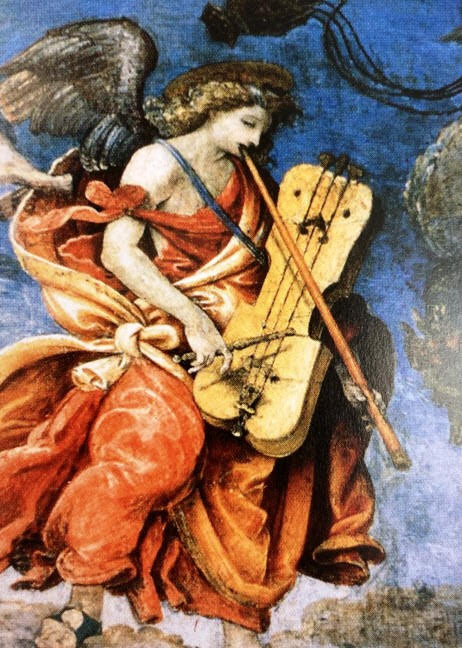
 The first musical instrument mentioned in the Bible in Genesis 4:21, is translated today as ‘harp,’ and to be more specific it is generally believed by scholars to have been a kinnor - two arms and a wood-framed box-shaped body, the string instrument most often depicted in ancient paintings and sculptures. We even have the name of the first string band member - his name was Jubal; the Bible tells us he was the father of all who play stringed instruments and pipes.
The lyre was next mentioned in the Bible, an instrument commonly used for secular music, but also welcomed in sacred use. This stringed instrument resembles an ancient harp but is smaller with fewer strings and provides support for singers and harps alike. The instrument is known by perhaps the ultimate church string band founder, King David. We hear of music’s importance in healing when David played the lyre to soothe King Saul (1 Samuel 16:16,23) and in ‘thanks giving and praise’ as read in 2 Samuel 6:5 - hence the ‘string church band founder’ accolades.
The kinnor (ancient harp) and lyre were not, as many assumed, the same instrument. Even dating back from ancient times, the lyre is characterized by its U-shaped frame, with strings attached to a yoke and sound box, typically having fewer strings compared to the harp. The design of both instruments influences their sound and playing techniques, with the lyre’s design allowing for a softer, more delicate sound, and the much larger harp able to fill a chamber or courtyard with sound.
Over the centuries many versions of the harp and lyre evolved, changes affected by types of music, the available materials to construct the instruments (better wood, glue and strings) and singing voice styles. Both of these, the harp and lyre instruments also influenced the creation of other string based instruments. Soon strumming, picking, drumming (the strings) and eventually ‘bowing’ would lead to the creation of what we consider our modern day instruments - such as the mountain dulcimer, autoharp, guitar, the violin family (violin, viola, cello and bass violin), mandolins, banjos, hammer dulcimer, even the ukulele and zither.
One could say that the peak of variety of musical stringed instruments was around the year 1900 - six thousand plus years after Jubal fathered string instruments - when the industrial revolution coincided with the American church mission and revival period (1870 -1920s). It is at this time that we see new churches, often on what was then the very rural western settlement frontier regions, create church string bands to support congregational singing.
Ironically, it was many foreign born protestant missionaries helping to set up these American Churches – people from Sweden, Germany and the Netherlands who traveled west providing many of the first Church outposts ever established in those remote areas of northern Michigan, Wisconsin, Minnesota, Missouri, Oklahoma, and Utah. It is no surprise then that as these church founders did their work, they brought with them and even promoted their homeland’s portable stringed instruments of choice. Swedish and German hummels (the grandfather of the Appalachian dulcimer), round backed mandolins, the bowed psaltery, and zithers (parent of the autoharp).
Once church buildings were erected and the towns around these establishments more organized, small communities became more prosperous. In tandem with the industrial revolution of the period came improved agriculture, transportation, and innovations in communication… and of big importance: a postal system that could provide reasonable service to even obscure areas. Letters from church supporters could flow to and from, and to everyone’s amazement, the new rural free delivery (RFD) service started by the U.S. Post office on October 1, 1896, would allow boxes of sheet music as well as violins, mandolins, banjos and guitars to be delivered through the mail. It should be mentioned that while subsidized a bit by the U.S. Government for the first decade, in 1906 the world ‘free’ was dropped from the name, but the service continued into the twentieth century. The trifecta of churches having money, instrument builders having machines, and a way to cheaply and safely deliver those stringed instruments, led to an explosion of church string bands – some utilizing some odd looking instruments (see Free Mission Church string band photo below).
For some perspective on the instrument sources for the early 1900s church band, we should know more about the stringed instrument makers. Up until the 1870s, America was not well known for any serious instrument builders. Most violins and even guitars came from Europe until the early 1900s. For instance, one very smart reseller of instruments was Rudolph Wurlitzer. He came to the United States in 1853 and started an import business selling instruments to the U.S. government during the Civil War. Being a middleman was nothing new to him, as the Wurlitzer family started buying and selling musical items in Saxony as far back as 1659. Soon after immigrating to the States, Rudolph Wurlitzer became the largest instrument supplier in America. Through a chain of retail stores in Chicago, he even started marketing a line of pianos and pump organs which his company manufactured. It wasn't long before Rudolph attached a coin slot to a player piano and literally started the east coast coin-operated music boom of the late 1890s. Later successes with the grand organs for which his name is synonymous did not happen until the age of silent films, when every movie theater needed organ music to accompany the film. How is this important to the church string band, you ask? Well, from 1880 to around 1920, Rudolph Wurlitzer’s group was buying up almost every violin, viola, upright bass and guitar made in Mirecourt, France or Saxon Germany, and then shipped them all to the US. It is said he imported almost four million stringed instruments during that period. This success did not go unnoticed!
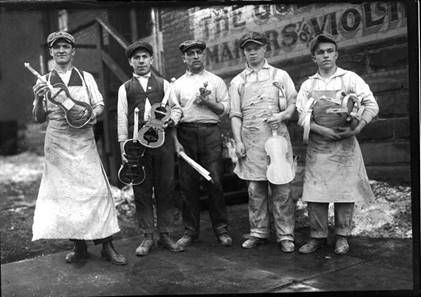
Luthiers (string instrument builders) from Germany and France took notice of where all the instruments they were making were going. Soon the instrument makers themselves were heading for the States in search of opportunity. Understanding the ins and outs of using new technology in violin making, George Guldan, for example, traveled to the US in the late 1890s from Germany, and in 1911 started making violins. Through the "The Guldan Violin Co.,” George Guldan was crafting “made in the USA” violins with his luthier, E. M. Fitzwater, from around 1911 through 1915. His ambitions and prototypes drew investors, and in 1915 his company became the ‘Jackson-Guldan Violin Company’ famed for having some of the first all machine made violins. Millions of instruments were made from 1920 to 1950. They did have some quality control, and if the instrument did not meet the factory quality standard it was sold as an ornamental candy dish or planter! It should be mentioned that by 1930, however, music teachers refused to teach anyone with a “student version” of a Jackson-Guldan violin, as the quality fell below minimum standards, and students would have to tune between every song.
Also inspired by Wurlitzer’s empire, by the late 1890s, America finally did have some of its own home grown luthiers become notable instrument builders. Orville Gibson started making instruments and soon after founded his company in 1902 as the Gibson Mandolin-Guitar Mfg. Co. Ltd. in Kalamazoo, Michigan. His initial goal was to make mandolin-family instruments: mandolins, mandocellos, and octave mandolins that were more popular than guitars at that time. It should be noted that Gibson’s invention of the famous archtop guitar came as an evolution of his earliest known instrument, a 10-string mandolin-guitar, which bears the date 1894.
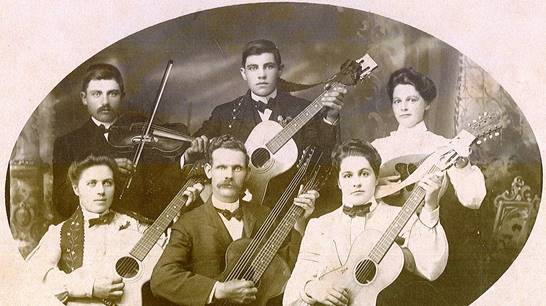
As we now gaze back on some of the first church string band photos from the 1900s, we can see some of those brand new industrial revolution stringed instruments ready for play, in the hands of the actual musicians. Violins, early guitars, round backed mandolins, are easy to spot. Yet some instruments not as easy to identify – there is even a double necked guitar-like instrument that should draw some curiosity!
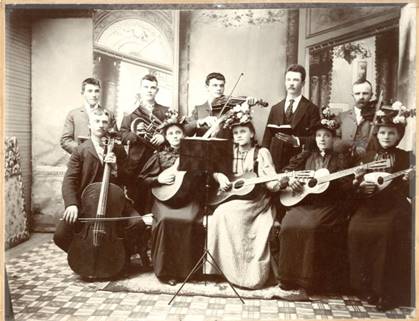
The photos are worth some time to consider, and can teach us about our own history. As string players in 2026, we might jump into saying “that’s a cello in the photo”. However, this is not necessarily the case. Historically, the cello and double bass would play the same parts but now today cellos operate in a more tenor range while the basses still provide deep low tones that carry the music. The cello and double bass may also appear to be very similar instruments but they actually have many differences that are important to know – especially if you’re a strings player! Double basses and cellos, despite looking somewhat alike, are actually from different historical string instrument families. Like the violin and viola, the cello comes from the violin family that was developed in the 16th century. The double bass, however, is believed to have evolved from the earlier (15th century) viol family – in particular, the violone (which was the bass viol). In fact, early double basses were conversions of violones. This is why many double basses don’t have the pointed corners that cellos, violas, and violins have – their design is more associated with viols than violins.
Until the industrial age, corners have also been historically difficult to carve out on an instrument the size of the bass. However, some basses nowadays do have these corners – they’re often referred to as “violin-shaped” whereas the older style is referred to as “gamba-shaped.” So what IS in the photo? Based on the shape of the upper plate (face), its width leads us to believe it is indeed an undersized contrabass (upright or double bass) and while the musician might have wanted a larger version, its size was more easily shipped by the post office at that time. Price might have been a deciding factor - we do not know for sure.
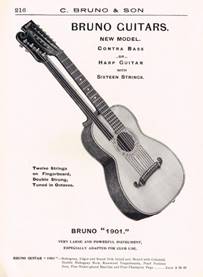
And what of that double necked guitar-like instrument? Well, it’s actually just one more bit of proof of the American creativity and ingenuity one might expect during boom times. In this case, in the Free Mission Church string band photo above, it’s the “Bruno 1901” – advertised as “a large and powerful instrument, especially adapted for club use.” It was advertised at $50 at the time – a small fortune, as people back then might say. This Bruno factory made guitar marvel was available in 12 or 6 strings on the main fingerboard, with an additional bass set of strings on the upper fingerboard.
Beyond the odd instrument or two in these historical church string band photos, one might think that in 2026 not much has changed, with the exception of amplification and electric guitars - but that would not be accurate. Even with acoustic instruments, the change to a majority of both new and old instruments has occurred; the strings themselves being more metal than natural materials (such as gut) plays an important role in the sound quality and volume, sustainability and longevity time of our playing.
We could also be led to believe that 125 years later more of everything we need would be available to our string bands. The truth is many things are disappearing - some not important, and others more so. Since the following does impact our state of play today, we’ll list seven to consider:
- Quality of the instruments is becoming a big issue as with cheap Chinese instruments flooding the market, there are fewer quality manufacturers left in business in other parts of the world - even the original Gibson Guitars is gone. Yes, there are some credible well-made Chinese made instruments here and there, but given the import statistics, the percentage of worthy instruments manufactured is deemed very low. Unfortunately, the cheap price reflects the quality and even one’s ability to stay in tune for more than a song or two.
- It is inevitable that certain 1900s musical instrument ideas would not survive, as they were gimmicky and not truly as practical as advertised back then. The Bruno 1901 is a good example of just this sort of instrument demise.
- Our knowledge of string music possibilities, the sounds that set us apart from pianos, organs and trumpets, is also disappearing. For example, when was the last time you noticed a mandocello in a string band? Have you ever heard one? Yes, they are still out there, available, but quite rare. We must remember - it’s easy to put blinders on as a string player. However, “instrument myopia” is cured by playing together in the church string band!
- As an individual or as a group it’s easy to copy (cover, emulate, steal licks) from a YouTube video. But are we trading our skill development and our ‘take’ of the sheet music for someone else’s sound? If we’re not conscious of this, we risk everyone eventually sounding the same.
- A bigger concern: what if the inspirational revival hymns that were once loved were notcaught on digital format or video? Not to be hypocritical now, but this is where YouTube and similar media might have some value to the preservation of some music forms. Have a listen to an almost lost traditional hymn, salvaged by folk music historian John McCutcheon, “Christ was born in Bethlehem,” performed by Tim and Mollie O’Brien, and you will hear how a mountain dulcimer can transform the strings and the singing into pure and simple praise. Even harder to find, by the way, is the credit to Nick Forster on playing that dulcimer in the O’Brien recording.
- The small town music shops are disappearing, and more importantly for those who play nicer string instruments, the luthiers are disappearing. These are the people who build, set and repair stringed instruments. Amazon might be able to sell you cheap shiny instruments that work for a time, but they will not reset a sound post in your violin nor fix the bridge on your cello.
- Modern music programs and lessons (especially those on line) often don’t even mention care and maintenance of one’s instrument.How and when to change strings, how, why, and with what to clean a finger board is part of the disappearing knowledge base that comes from a disposable instrument mindset.
There are a great deal of details in topics mentioned in this article, but not fully explored. To conclude, it must be said that a church string band that appreciates and learns from each other, its older members, and historical church string bands, has the opportunity to pass the knowledge on, and create sustainability. Thank you for playing for our congregation, and also thank you for taking your time to learn about those who came before you.
God Bless.